In brief
- The refrigerator is rarely the right answer: the condensation that forms when the product returns to room temperature does more damage than ambient heat.
- What degrades the product changes from one family to another: humid air for nougatine, drying out for marzipan, crystallisation for candied fruit.
- Hazelnut crunch is a dry, robust product: it keeps without difficulty at room temperature. It is nougatine that loses its crunch in open air.
- Marzipan is wrapped in contact with the film, never in a bag of air. A crust forms in under an hour on an exposed surface.
- The best-before date printed on the label is what counts, and on our marzipan bars it is marked on the product itself. It assumes a product that has stayed properly protected.
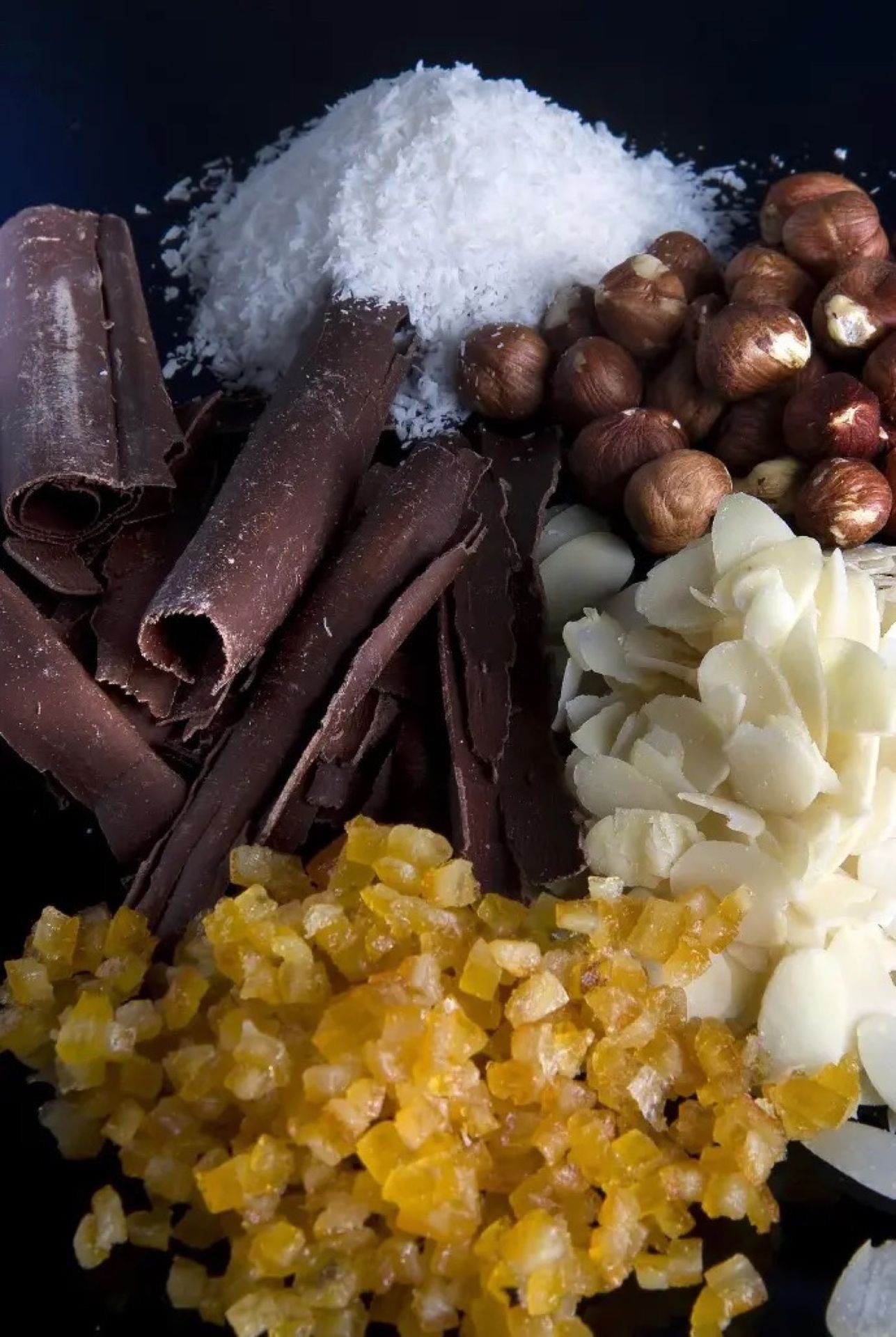
Most raw-material losses in confectionery come not from an expired date but from a badly chosen storage condition. A bag of nougatine left open in a humid workshop loses its crunch irreversibly. Unwrapped marzipan forms a crust that will crack on every piece. As a Brussels manufacturer since 1988, we see these cases come back every year. Here are the storage conditions product by product, the five costliest mistakes, and what the best-before date printed on our packaging actually means.
What degrades each product?
À retenir : There is not one storage rule but several, because the degradation mechanisms differ from one product to another.
| Product | What degrades it | Key condition | Warning sign |
|---|---|---|---|
| Marzipan and almond paste | Drying out and picking up odours | Wrapped in contact, sheltered from air | Crust on the surface, cracks when shaping |
| Hazelnut crunch | Direct moisture: steam, condensation, a wet container | Container closed again, away from steam zones | Grains sticking to one another |
| Nougatine | The humidity of ambient air, once the bag is open | Airtight bag closed again, or transferred to an airtight bucket | Sticky sheets, clumped granules |
| Ground almonds and almond flour | Oxidation of the fat | Cool, dry, sheltered from light | Rancid smell, lumps |
| Candied fruit | Drying out and crystallisation | Closed container, stable temperature | Crystals on the surface, hard texture |
Erreur fréquente : The common mistake is to apply a single rule to the whole workshop. What protects marzipan, the absence of air, does nothing for ground almonds, whose problem is oxidation. And the reverse is equally true.
Why is the refrigerator rarely the right answer?
Because the condensation that forms when the product returns to room temperature does more damage than the heat you were trying to avoid. This holds for every product discussed here.
The mechanism is simple: a cold product brought out into a warm workshop captures the humidity of the air on its surface. On nougatine, that water destroys the crunch irreversibly. On coloured marzipan, it makes the sugar weep and dulls the shades.
Recommandation : If a spell in the cold is unavoidable, take the product out in its closed packaging and let it come back to temperature before opening. The condensation then forms on the packaging, not on the product.
How do you store marzipan?
Wrapped in contact, at a stable room temperature, sheltered from light and from strongly scented products. Almond picks up odours with formidable efficiency.
Three workshop rules. Wrap in contact and not in a bag of air: an exposed surface forms a crust in under an hour. Never store near spices, coffee or cleaning products. And work in small quantities, keeping the rest wrapped.
For pieces already shaped and coloured, avoid direct contact between different colours, as the shades migrate. What separates the different almond contents and their uses is detailed in our definition of marzipan.
How do you store hazelnut crunch and nougatine?
Hazelnut crunch is a dry product: it keeps without difficulty at room temperature, and open air does not make it lose its crunch. Nougatine is markedly more sensitive.
That difference dictates the packaging. Our nougatine ships in an airtight plastic bag, precisely because the humidity of ambient air is enough to soften it. Once the bag is open, use the product quickly or transfer it to an airtight bucket.
Hazelnut crunch ships in cartons, buckets or 20 kg bags; of those formats, only the buckets are airtight. What it fears is not ambient air but direct moisture: steam from a steamer, a wet utensil, condensation on leaving the cold. Close the container after every scoop and keep it away from washing areas. Grain sizes and dosages are detailed in the coupe brésilienne.
How do you store ground almonds and candied fruit?
For ground almonds and almond flour, the limiting factor is oxidation of the fat, not microbiological risk. Hazelnut ages faster than almond, its fat being more fragile.
Store them cool, dry, sheltered from light, in an airtight container, and respect the rotation. The classic mistake is always to draw from the most accessible bag, which leaves the others to age. See grinding in pastry.
Candied fruit, for its part, fears drying out and crystallisation of the sugar on the surface. A closed container and a stable temperature are enough in most cases. Choosing and using it is covered in candied fruit: how to choose, use and store it.
The five costliest workshop mistakes
They come back every year, and not one of them requires an investment to be corrected.
| Mistake | Consequence | Correction |
|---|---|---|
| Storing near the ovens or a washing area | Heat and steam, crunch lost, fat that migrates | A dedicated storage area, away from sources of heat and humidity |
| Leaving a bag of nougatine open between two uses | Moisture uptake, clumped granules | Close the airtight bag again or transfer to an airtight bucket |
| Breaking batch rotation | Out-of-date products at the back of the shelf | Labelling on receipt, first in first out |
| Putting a crunchy product in the cold without protection | Irreversible condensation on return to temperature | Take it out in its closed packaging and temper before opening |
| Storing marzipan next to strongly scented products | Almond picks up odours, the taste is altered | Physically separate the product families |
Le saviez-vous ? : The cumulative cost of these five mistakes almost always exceeds the price gap between two suppliers. That is why measuring losses is a workshop's second saving lever, as detailed in cutting your raw material costs.
What does the best-before date mean, and how far does it commit us?
The best-before date guarantees the taste and the characteristics of the product, provided it has stayed properly protected. It is not an estimate: at Silly Belgium, every date is established after a series of tests on the real product.
Two practical consequences. The date must be respected: beyond it, we no longer guarantee taste, texture or behaviour in production. And it does not survive careless storage: a best-before date assumes resealed packaging, a stable temperature and the absence of humidity. An open bag next to an oven holds no date at all.
Where to read it: on the label of the packaging, and for our marzipan bars printed directly on the product. If you have a doubt about a batch, one message settles it through the contact form.
Our products and their packaging
Silly Belgium manufactures in Jette, in Brussels, since 1988: marzipan from 22 % to 50 % almond, in cartons of 5, 10 or 15 kg, in buckets of 4, 5 or 6 kg and in bars of 250 g, 500 g or 1 kg; hazelnut crunch in cartons of 5 to 10 kg, buckets of 2 to 5 kg and 20 kg bags; nougatine in rounds, squares and granules; and the grinding of almonds and hazelnuts.
Choosing the format is also a storage decision: order the largest packaging your rotation absorbs, not the largest available. To discuss it, write to us through the contact form.
FAQ: storing raw materials
How should marzipan be stored?
Wrapped in contact, at a stable room temperature, sheltered from light and from strongly scented products. An exposed surface forms a crust in under an hour, which will crack when shaping. Almond picks up odours strongly: keep it away from spices and coffee.
Should almond paste go in the refrigerator?
Generally not. The condensation on returning to room temperature makes the sugar weep and dulls the colours. If a spell in the cold is necessary, take the product out in its closed packaging and let it temper before opening.
Does hazelnut crunch lose its crunch in open air?
No. It is a dry product that keeps without difficulty at room temperature and in the open. What it fears is direct moisture: steam, a wet utensil, condensation. Nougatine is far more sensitive to the humidity of ambient air.
How do you store nougatine once the bag is open?
Use it quickly or transfer it to an airtight bucket. We ship it in an airtight plastic bag precisely because the humidity of ambient air is enough to soften it: once that bag is open, the protection is gone. A bag simply folded over does not replace a closed container.
What does the best-before date on marzipan guarantee?
It guarantees the taste and the characteristics of the product up to the stated date, provided it has stayed properly protected. Beyond that, we no longer guarantee those characteristics. The date is on the label, and on our marzipan bars it is printed on the product.
Should candied fruit be kept cold?
It is generally not necessary. What they mainly fear is drying out and crystallisation of the sugar on the surface. A closed container and a stable temperature are enough in most cases, without exposing them to the condensation of a spell in the cold.
Sources
Got a project? Let's talk.
A question about the storage or the best-before date of one of our references? Write to us through the contact form, we answer batch by batch.
Request a sample