In brief
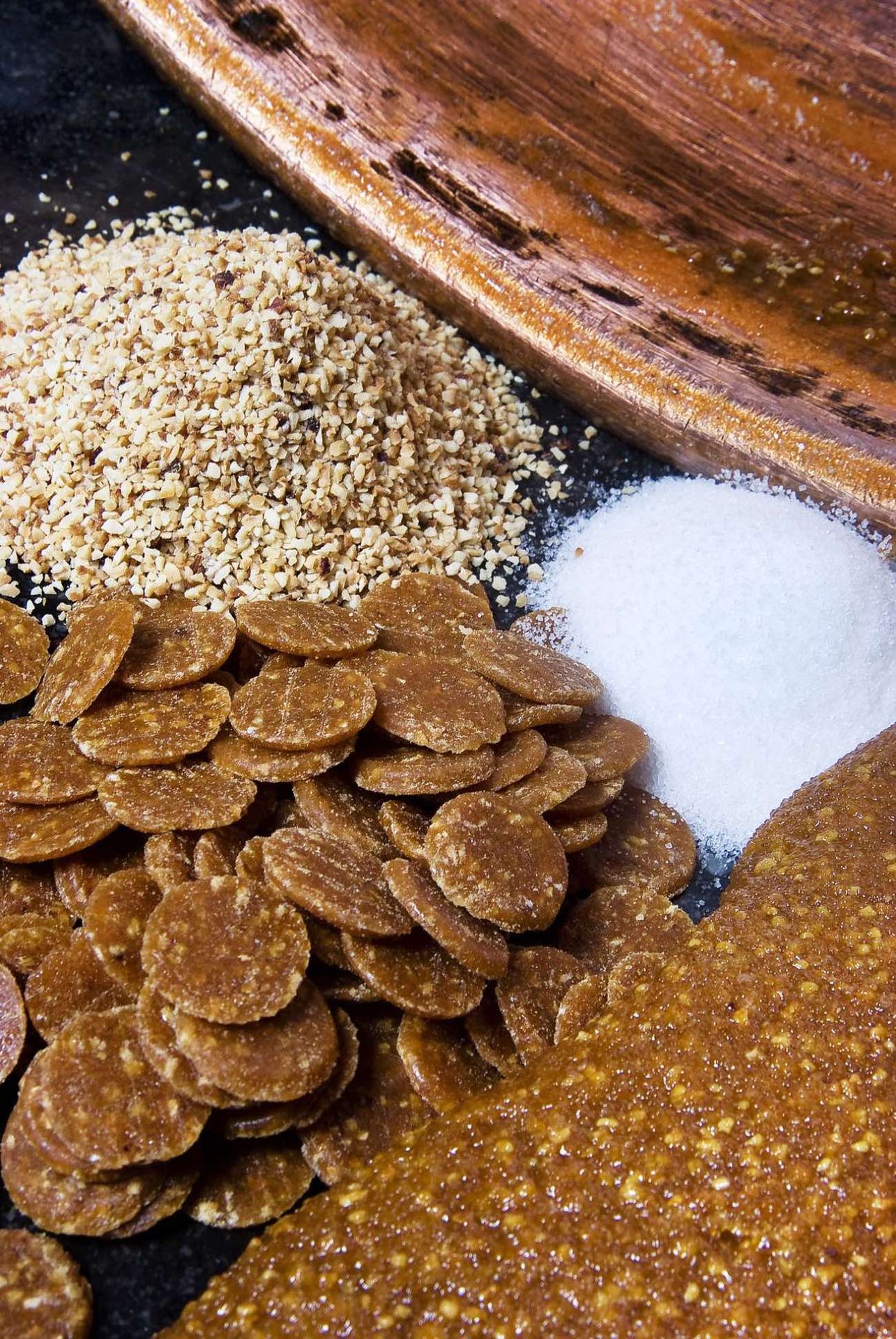
- Three raw materials structure the Belgian repertoire: hazelnut crunch (praligrain), marzipan (almond paste) and nougatine.
- The hazelnut crunch tart is the most identifying: it barely exists anywhere else in this form, and its name comes directly from the ingredient.
- Marzipan appears in three distinct forms in the Belgian repertoire: baked filling, covering and modelled figure.
- The Belgian repertoire is strongly seasonal: marzipan peaks at Christmas and Easter, filled speculoos at Saint Nicholas.
- The Belgian specificity is not a recipe but an intensive use of the caramelised hazelnut, where France favours praliné as a paste.
Belgian pastry is less codified than the French and less protected than the German, but it has a recognisable signature: the intensive use of the roasted, caramelised hazelnut, in grains rather than as a paste. Three raw materials recur in most of its classics: hazelnut crunch, marzipan and nougatine. As a manufacturer of all three in Brussels since 1988, we offer here a tour of the pastries that depend on them, from the hazelnut crunch tart to the banketstaaf, with their real seasonality.
What characterises Belgian pastry?
À retenir : The Belgian signature lies in an intensive use of the caramelised hazelnut in grains, where the French tradition favours praliné as a paste. It is a difference of texture before it is a difference of taste.
That preference has a concrete consequence: Belgian pastries play heavily on the contrast between a creamy base and a frankly crunchy element. Hazelnut crunch, chopped roasted hazelnuts coated in caramelised sugar, is the main vehicle of that contrast.
The second trait is the place of marzipan, less as a confection than as a material: filling, coating, modelling of subjects. That culture of shaping explains the presence of marzipan in Belgian display cabinets all year round, and not only at festivals.
Which Belgian classics are built on hazelnut crunch?
Hazelnut crunch is the most identifying ingredient of the Belgian repertoire, to the point of giving its name to two whole desserts.
| Classic | What it is | Role of the hazelnut crunch |
|---|---|---|
| Hazelnut crunch tart | Pastry base, cream, a generous layer of hazelnut crunch | The main ingredient, not a finish |
| Coupe brésilienne | Mocha and vanilla ice cream, caramel, whipped cream | The finish that gives it its name and its texture |
| Belgian Christmas log | Rolled sponge, buttercream or praliné | Dusting as a finish, often in fine grain |
| Chocolatier's pralines | Coated ganache or praliné | Crunchy filling or outer finish |
The hazelnut crunch tart is the one that travels least and identifies most. Its full recipe is given in hazelnut crunch tart: the maker's recipe, and the frozen dessert in the coupe brésilienne.
Which classics are built on marzipan?
Marzipan appears in three distinct forms in the Belgian repertoire: as a baked filling, as a coating and as a modelled subject.
| Classic | Form of the marzipan | Season |
|---|---|---|
| Filled speculoos | Baking marzipan as a filling | Saint Nicholas, December |
| Banketstaaf | Baking marzipan rolled in puff pastry | December, Flemish tradition |
| Potatoes and little pigs | Marzipan modelled and coloured in the mass | Christmas and New Year |
| Trompe-l'œil fruits | 33 % marzipan shaped and coloured | Festivals, weddings |
| Marzipan logs | Marzipan coated or filled | Christmas |
Le saviez-vous ? : Filled speculoos and banketstaaf are two markers of the Flemish tradition, very present at Saint Nicholas. What they have in common is the use of baking marzipan, not a modelling marzipan: the formula is different. See filled speculoos and banketstaaf.
And nougatine, where do you find it?
In Belgium, nougatine plays a structural role more than a decorative one: it carries, it does not garnish.
You find it as a tart base, where its sheet of about 2.5 mm provides a crunchy foundation resistant to the moisture of the cream. In a mounted piece, it serves as a plinth. As granules of 0 to 3 mm, it tops cakes, ice creams and chocolates.
The available shapes (rounds of 20 and 25 mm, squares of 8 to 25 mm, granules) and their uses are detailed in nougatine: the complete guide.
How is Belgian seasonality distributed?
The Belgian repertoire is strongly seasonal, and that seasonality structures a workshop's supply far more than its menu.
| Period | What dominates | Ingredient called on |
|---|---|---|
| September to October | Preparing the festive volumes | Modelling marzipan, raw material order |
| November to December | Saint Nicholas, Christmas, New Year | Marzipan, baking marzipan, hazelnut crunch |
| March to April | Easter | Modelled marzipan, chocolate work |
| May to September | Ice cream sundaes, tarts, terraces | Hazelnut crunch, nougatine in granules |
| All year round | Individual pastries, pralines | Hazelnut crunch, almond cream |
Recommandation : Anticipate marzipan orders from September. Demand is concentrated into six weeks and both shaping and drying take time. The use of marzipan on the end-of-year markets is told in marzipan delights at the Christmas markets.
Sourcing in Belgium
Silly Belgium makes the three raw materials of this repertoire in Jette, Brussels: marzipan in five grades from 22 % to 50 % almond, hazelnut crunch in four grain sizes, and nougatine in copper pans. Since 1988, with HACCP procedures applied since 2001 and FSSC 22000 certification since 2021.
Samples and technical sheets through the contact form.
FAQ: Belgian pastry
What are the specialities of Belgian pastry?
The hazelnut crunch tart, the coupe brésilienne, filled speculoos and the banketstaaf are among the most identifying. All rest on three raw materials: hazelnut crunch, marzipan and nougatine.
What differentiates Belgian pastry from French pastry?
The use of the caramelised hazelnut in grains rather than as a paste. Where the French tradition favours incorporated praliné, Belgium plays on the contrast between a creamy base and a frank crunch brought by hazelnut crunch. It is a difference of texture.
What is the hazelnut crunch tart?
A Belgian tart made of a pastry base, a cream and a generous layer of hazelnut crunch, those chopped roasted hazelnuts coated in caramelised sugar. The hazelnut crunch is the main ingredient there, not a finish: that is what sets it apart from a tart that is merely decorated.
What is a banketstaaf?
A classic of the Flemish December tradition: baking marzipan rolled in puff pastry, baked as a bar and cut into lengths. It uses baking marzipan, formulated to survive the oven, and not a modelling marzipan.
When does Belgian pastry consume the most marzipan?
From mid-November to the end of December, around Saint Nicholas, Christmas and New Year, then at Easter in March and April. Workshops place their orders from September, since shaping and drying the subjects take several weeks beforehand.
Where can you find the ingredients of the Belgian classics?
From Belgian manufacturers who produce marzipan, hazelnut crunch and nougatine. The useful criterion is the ability to adjust almond content, grain size and format to your recipe, which a manufacturer can do and a stock distributor cannot.
Sources
Got a project? Let's talk.
Silly Belgium makes the three bases of the Belgian repertoire in Brussels: marzipan, hazelnut crunch and nougatine. Samples on request.
Request a sample