In brief
- Three products born of the same ingredients (nuts, sugar, caramelisation) but assembled differently, hence three behaviours in the workshop.
- Pralin, praligrain and hazelnut crunch designate the same type of product: caramelised nuts in grains. The name changes with the market and with habit, not the product.
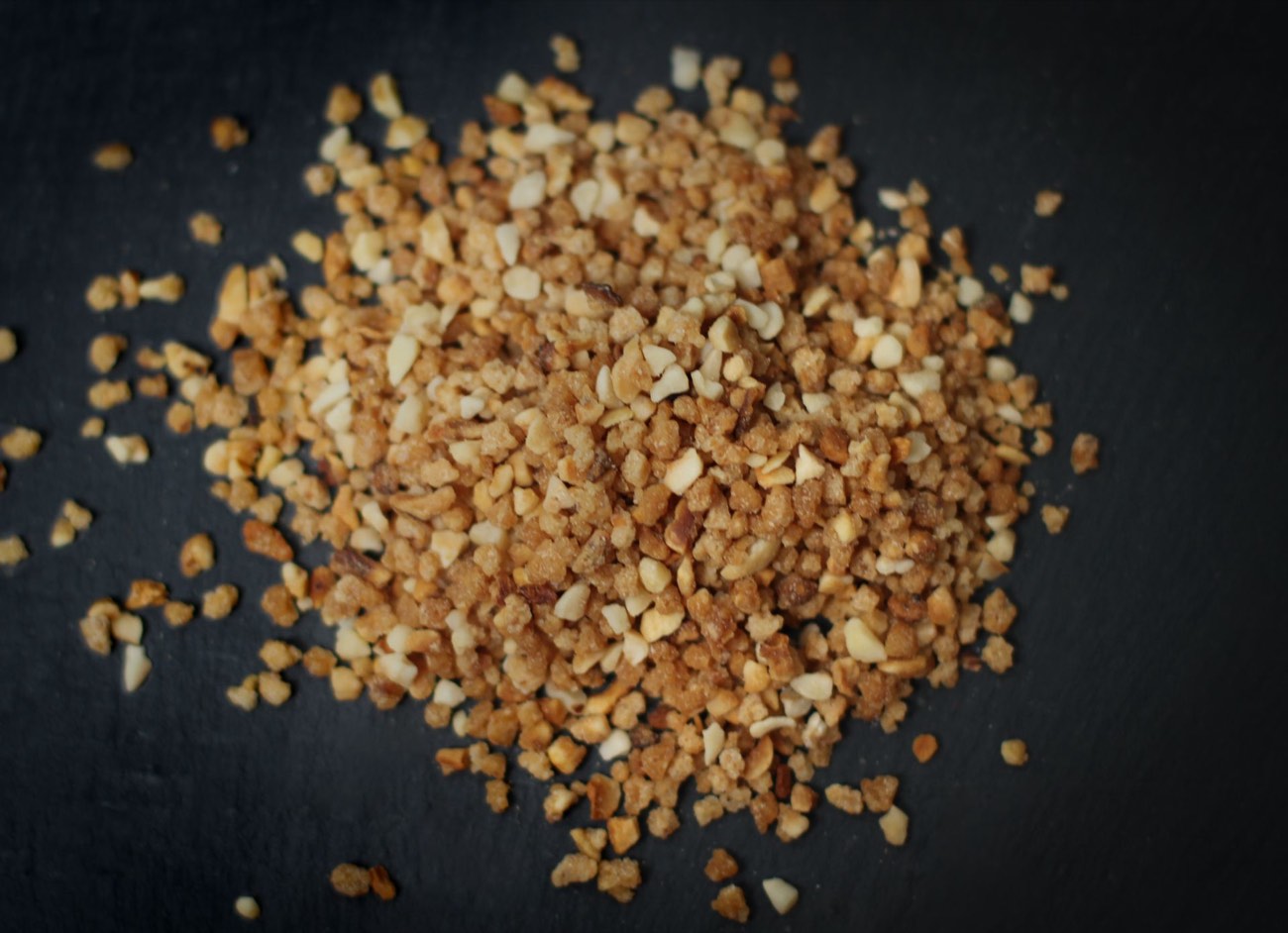
- Hazelnut crunch is made of grains individually coated in caramelised sugar: it stays loose, free-flowing, and does not go soggy on contact with cold.
- Nougatine is a solid mass of nuts set in caramel, shaped between cylinders: it is cut, it is broken and it acts as a support.
- Praliné is a paste obtained by grinding caramelised nuts until their fat is released: it is incorporated, it does not crunch.
Hazelnut crunch, nougatine and praliné all start from the same ingredients: almonds or hazelnuts, sugar, and heat. What separates them is not the recipe but the moment the process is stopped and the shape given to the mass. A coated grain does not have the same use as a broken sheet or a ground paste. Add to that a difficulty of vocabulary: pralin, praligrain and hazelnut crunch designate the same type of product depending on the market. Silly Belgium has made hazelnut crunch and nougatine in Brussels since 1988. Here is the comparison table that avoids ordering mistakes, and the real selection criterion: resistance to moisture.
What distinguishes these products?
À retenir — The process stops at three different points, and that stop is what defines the product. Individual coating of the grains, a solid mass, or grinding through to a paste.
| Product | What it is | Texture | What it does in the workshop |
|---|---|---|---|
| Hazelnut crunch, also called pralin or praligrain | Chopped roasted hazelnuts, coated in caramelised granulated sugar | Loose grains, crunchy, free-flowing | Is dusted, incorporated, used as decoration |
| Nougatine | Roasted almonds or hazelnuts set in caramelised sugar, then shaped | Solid mass, brittle | Is cut, broken, used as a support |
| Praliné | Caramelised nuts ground until the fat is released | Fluid to unctuous paste | Is incorporated, flavours, does not crunch |
Erreur fréquente — The most frequent ordering mistake confuses hazelnut crunch with granulated nougatine. Both come as grains in a bag, but granulated nougatine is solid caramel broken up, whereas hazelnut crunch is a coated hazelnut. On the palate, the first crackles, the second crunches.
How is hazelnut crunch made?
Four gestures: selection, roasting, crushing to the required grain size, then coating in caramelised granulated sugar. It is the coating that makes the product distinctive.
Every fragment of hazelnut is individually covered in caramel. The result stays free-flowing: the grains do not cake together and can be dosed with a spoon. The particle size is set in production, from 2 mm to 4 mm depending on the effect sought.
It is called brésilienne in Belgium, praligrain or pralin in France and on other markets. Its full process is described in what is hazelnut crunch (praligrain).
How is nougatine different?
Nougatine is a continuous mass: roasted nuts are incorporated into caramelised sugar, then the whole is shaped between rollers. The caramel binds everything, it does not coat.
At Silly, manufacture takes place in copper pans, following an age-old method. The cooking time, the working of the mass and the composition must be very precise to obtain the intended colour, texture and taste. The mass is then passed between rollers into sheets of about 2.5 mm.
| Shape | Dimensions | Use |
|---|---|---|
| Rounds | 20 and 25 mm | Tart bases, dessert bases |
| Squares | 8, 12, 20 and 25 mm | Decorations, inclusions, finishes |
| Granules | 0 to 3 mm | Topping for cakes, ice creams, chocolates |
The complete guide to the product is in nougatine: the complete guide, and its glossy version in glossy nougatine.
Pralin, praligrain, hazelnut crunch: is it the same product?
Yes. Those three words designate the same type of product: roasted, chopped and caramelised nuts, presented in grains. The name varies with the market and with habit, not the nature of the product.
It is a daily source of error. A French buyer ordering praligrain, a chocolate maker asking for pralin and a Belgian pastry chef speaking of brésilienne are all after the same thing. The real gaps between offers concern the nut used, the grain size and the degree of caramelisation, never the word.
Praliné, on the other hand, really is a different product. The grinding of the caramelised nuts is pushed until their fat is released and binds the mass: the result is a paste, more or less fluid depending on the fineness. It is incorporated into a ganache, a cream or a filling, and it flavours without adding crunch. The process of praliné and its uses are detailed in praliné: what it is and how it is made.
What is the selection criterion in the workshop?
The decisive criterion is not the taste, it is resistance to moisture and cold. The four products have very different profiles on this point, and that determines whether the texture survives to the plate.
| Product | Resistance in a humid setting | Resistance on ice cream | Is worked by |
|---|---|---|---|
| Hazelnut crunch (pralin, praligrain) | Good, thanks to the individual coating | Very good, does not go soggy | Dusting, inclusion, coating |
| Nougatine | Moderate, the caramel absorbs moisture | Limited in a thin sheet, acceptable as granules | Cutting, support, rigid decoration |
| Praliné | Not applicable, it is a paste | Not applicable | Incorporation, filling, ganache |
Recommandation — For anything served cold or assembled in advance (sundaes, entremets, display case), hazelnut crunch is the default choice. For a crunch that has to carry a structure, it is nougatine. Praliné is not laid on the surface: it is worked into the mass.
What are these products called abroad?
The equivalents exist but do not overlap perfectly, which complicates cross-border orders.
| Product | France | Netherlands and Flanders | Italy | Germany |
|---|---|---|---|---|
| Hazelnut crunch | Praligrain | Bresilienne | Granella di nocciole caramellate | Krokant (in the broad sense) |
| Nougatine | Nougatine | Nougatine | Croccante | Krokant |
| Praliné | Praliné | Praliné | Pralinato | Pralinémasse |
Le saviez-vous ? — The German and Dutch word Krokant and the Italian croccante designate nougatine first of all, not hazelnut crunch. Ordering krokant expecting coated grains is a classic confusion on the German-speaking and Dutch-speaking markets.
Where can you order these products in Belgium?
Silly Belgium makes hazelnut crunch (up to 5,000 kg a day, grain sizes from 2 to 4 mm) and nougatine in copper pans (rounds, squares and granules) in Jette, Brussels. Hazelnuts Rainforest Alliance Certified, production certified FSSC 22000.
To compare the textures on your own recipes, request samples of both products through the contact form.
FAQ — hazelnut crunch, nougatine, praliné and pralin
What is the difference between nougatine and hazelnut crunch?
Nougatine is a solid mass: roasted nuts set in caramelised sugar, shaped between rollers, which can be cut and broken. Hazelnut crunch is made of hazelnut grains coated individually in caramel, which stay loose and are sprinkled.
What is the difference between praliné and pralin?
Pralin designates the same type of product as hazelnut crunch and praligrain: caramelised nuts in grains, which are dusted on and crunch. Praliné is a paste: the caramelised nuts are ground until their fat is released. One brings crunch, the other flavour.
Hazelnut crunch, praligrain and pralin: are they the same thing?
Yes, it is the same type of product under different names depending on the market: brésilienne in Belgium, praligrain or pralin elsewhere. It is chopped roasted nuts coated in caramelised sugar. The real differences between offers concern the nut, the grain size and the caramelisation.
Which product holds up best on ice cream?
Hazelnut crunch, without hesitation. Its caramel coating forms a barrier around each fragment of hazelnut and markedly delays moisture uptake. A thin sheet of nougatine softens rapidly on contact with the cream and the sauce. Add the grain at the last moment, just before it goes out.
Is Italian croccante the same as nougatine?
Yes, broadly. Croccante in Italian and Krokant in German as in Dutch designate the mass of caramelised nuts, therefore nougatine, and not hazelnut crunch. Ordering krokant while expecting coated grains results in receiving a different product.
Can nougatine be replaced by hazelnut crunch?
For a surface texture effect, yes, and often to advantage. For a structural function, no: a sheet of nougatine carries a piece, loose grains carry nothing. The question to ask is whether the crunch decorates or supports.
Sources
Got a project? Let's talk.
Silly Belgium has made hazelnut crunch and nougatine in Brussels since 1988. Samples of both products to compare on your recipes.
Request a sample