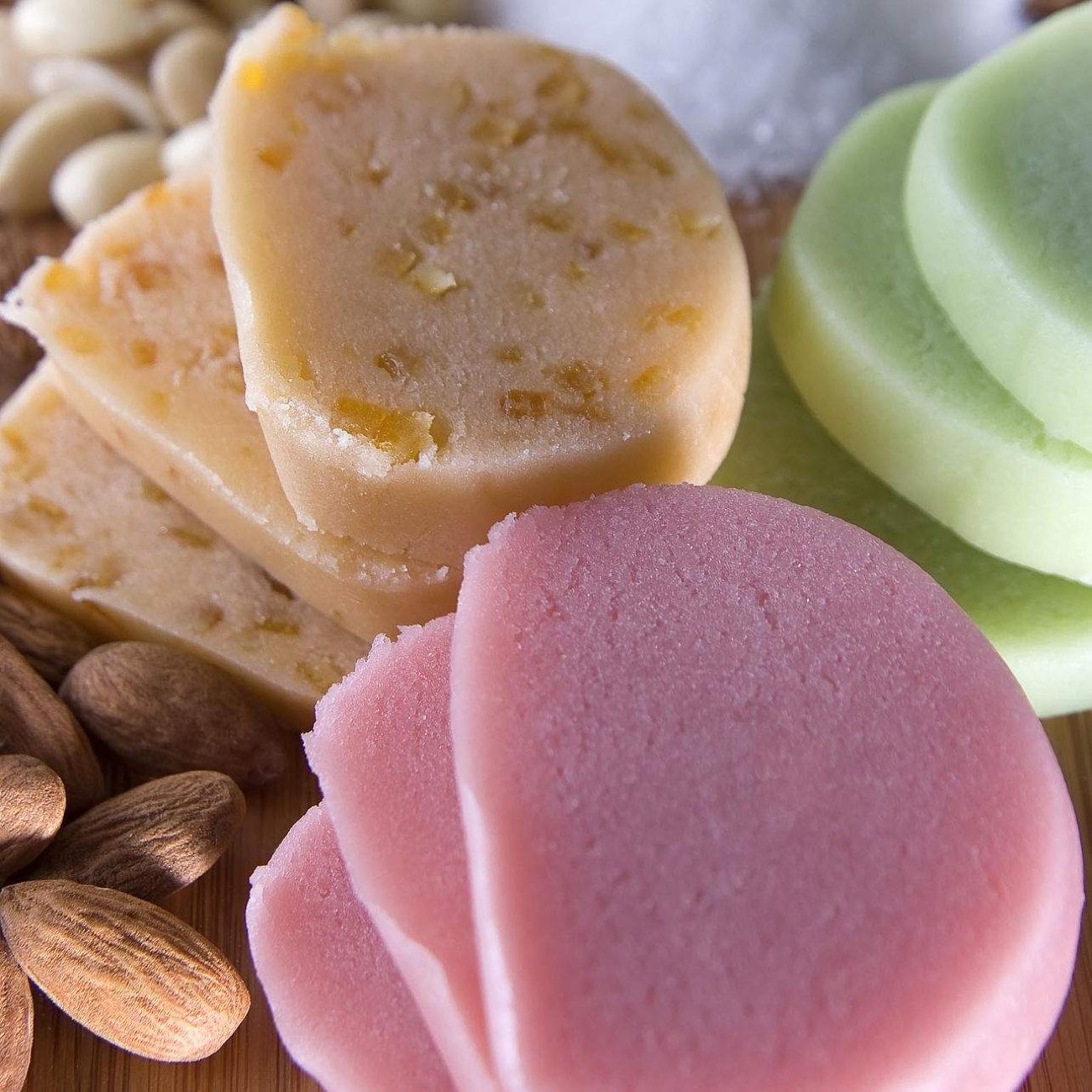
In brief
- Marzipan is a mixture of ground almonds and sugar, worked until it forms a homogeneous, pliable paste. Nothing else is needed to define it.
- The almond content is the only figure that matters: a 33 % marzipan contains 33 % almonds and 67 % sugar. The higher it climbs, the more assertive the almond note.
- In Belgium, « massepain » and « pâte d'amande » designate the same product. The useful distinction is not between the two words but between a paste for modelling and a paste for baking.
- Foreign equivalents do not overlap perfectly: massepain (FR), marsepein (NL), Marzipan (DE), amandelspijs (NL, for the baking version only).
- Three criteria separate the grades: the almond-sugar proportion, the origin of the almonds and any additions (candied orange, raspberry, pistachio, mocha).
Marzipan is a paste obtained by grinding blanched almonds and sugar together until a homogeneous, supple and shapeable mass is formed. That is all: two ingredients, no compulsory texturing agent. What varies from one marzipan to another is the proportion between the two, known as the almond content, which commonly runs from 22 % to 50 % almonds. Silly Belgium has made marzipan in Brussels since 1988. Here is the exact definition, what the five common grades cover, and why the word shifts meaning from one country to another.
What exactly is marzipan?
À retenir : Marzipan is a mixture of ground almonds and sugar, worked until it forms a homogeneous, pliable paste. That is a definition of composition, not of shape: the pink Christmas pig and the 5 kg block used as a filling are the same product.
Its flavour comes from the meeting of two opposing characters: the sweetness of the sugar and the subtle bitterness of the almond. That balance is why the almond content is not a technical detail but the central flavour parameter.
The texture is soft and melting, plastic enough to be shaped by hand without cracking. That pliability made marzipan the modelling material of European confectionery, centuries before sugar paste.
Marzipan or almond paste: is there a difference?
In Belgium the two words designate the same product and are used interchangeably. No Belgian regulation reserves either term for a precise composition. The real distinction, the one that changes something in the workshop, lies elsewhere.
| The question | The useful answer |
|---|---|
| Marzipan or almond paste? | Same product, two words |
| Modelling paste or baking paste? | Two different products, formulated for two uses |
| Which almond content? | The only figure that changes flavour and hold |
Erreur fréquente : Looking for a difference in composition between « marzipan » and « almond paste » is a dead end: both names circulate for the same products. The question that counts is: will this paste go into the oven or not? The answer is developed in baking marzipan or marzipan.
What does an almond content of 22 % to 50 % mean?
The almond content is the percentage of almonds in the paste: a 33 % marzipan contains 33 % almonds and 67 % sugar. Silly makes five grades, from the mildest to the most intense.
| Content | Character | Typical uses |
|---|---|---|
| 22 % | The mildest and most pliable, carried by the sugar | Large-volume modelling, soft fillings |
| 30 % | Balanced and versatile, a good flavour-hold compromise | Figurines, coatings, everyday pastry |
| 33 % | The fruity standard, the craft benchmark | Trompe-l'œil fruits, marzipan logs, coloured decorations |
| 40 % | Rich in almond and firmer, it holds the detail | Fine modelling, pieces that hold, detailed decorations |
| 50 % | The finest and most fragrant, intense almond note | Premium creations, chocolate work, refined finishes |
Recommandation : A high content is not « better » in absolute terms: it is more expensive, more intense and firmer. For large-volume modelling, a 22 % or a 30 % works more easily and costs less. The right content is the one that suits the piece, not the highest in the catalogue.
Which other criteria separate grades of marzipan?
Beyond the content, two criteria make the difference: the origin of the almonds and any additions. They explain why two marzipans showing the same percentage have neither the same taste nor the same price.
Origin first. Pastry almonds come mainly from the United States, Spain and Portugal, with distinct aromatic profiles. Silly buys its almonds at origin, in the growing countries, where they are shelled, blanched and packed before shipping.
Additions second. A specialty marzipan incorporates candied orange cubes, raspberry, pistachio or mocha paste. These are distinct products, often intended to be coated in praliné, and not cosmetic variants of plain marzipan. The criteria for testing a grade before ordering are gathered in craft or industrial marzipan, and how the content reads in the price is covered in what a good marzipan costs.
How do you say marzipan in French, Dutch and German?
The equivalents exist but do not overlap exactly, and that is a recurring source of ordering errors.
| Language | Term | Detail |
|---|---|---|
| Dutch | marsepein | Modelling paste, the direct Dutch equivalent |
| Dutch | amandelspijs | The established term, for the baking version only |
| French | massepain | Modelling paste, the direct French equivalent |
| German | Marzipan | Broad use; « Backmarzipan » for the baking version |
Le saviez-vous ? : Ordering marsepein in Dutch when you meant amandelspijs gets you a modelling paste where a baking filling was needed. The confusion is common on cross-border orders.
Where does marzipan come from?
Marzipan is one of the oldest European confections still produced without any major change of recipe. Its origin is disputed between the Mediterranean basin and the Near East, and its establishment in northern Europe owes much to the sugar routes.
We devoted a full article to that history, to the traditions attached to it and to the particular place of Belgian craftsmanship: the history of marzipan.
Where can you find professional marzipan in Belgium?
Silly Belgium makes the five grades described above (22, 30, 33, 40 and 50 % almonds) in Jette, Brussels, in plain marzipan as well as specialty marzipans. Contents, flavours, formats and packaging are adjustable. Production certified FSSC 22000, almonds bought at origin.
Discover the marzipan and almond pasterange, or request a sample through our contact form.
FAQ: marzipan
What is marzipan?
Marzipan is a paste obtained by grinding blanched almonds and sugar together until a homogeneous, pliable mass is formed. Two ingredients are enough to define it. Its almond-sugar proportion, called the almond content, commonly runs from 22 % to 50 %.
What is the difference between marzipan and almond paste?
In Belgium, none: the two words designate the same product. The distinction that matters in the workshop sets the modelling paste, intended for shaping and decoration, against baking marzipan, formulated to survive the oven inside a filling.
What does a 33 % marzipan mean?
That it contains 33 % almonds and 67 % sugar. It is the most widespread standard among Belgian craftspeople: fruity enough to be recognisable, supple enough to shape, and controlled in cost. Silly also offers 22, 30, 40 and 50 %.
Does marzipan contain gluten?
Plain marzipan, made of almonds and sugar, contains no gluten by nature. It does contain tree nuts, an allergen subject to mandatory declaration. For any formal guarantee, refer to the technical sheet for the batch supplied by the manufacturer.
Which almond content should you choose for modelling?
For large pieces, a 22 % or a 30 % works more easily and costs less. For fine decorations that must hold their detail, go up to 40 %. The 50 % is reserved for premium creations where the almond note has to dominate.
How do you say marzipan in Dutch?
Marsepein for the modelling paste, which is the direct equivalent of marzipan. Amandelspijs, by contrast, specifically designates baking marzipan, used as a filling. Confusing the two on an order means receiving the wrong product.
Sources
Got a project? Let's talk.
Silly Belgium makes five grades of marzipan in Brussels, from 22 % to 50 % almonds. Samples and technical sheets on request.
Request a sample