In brief
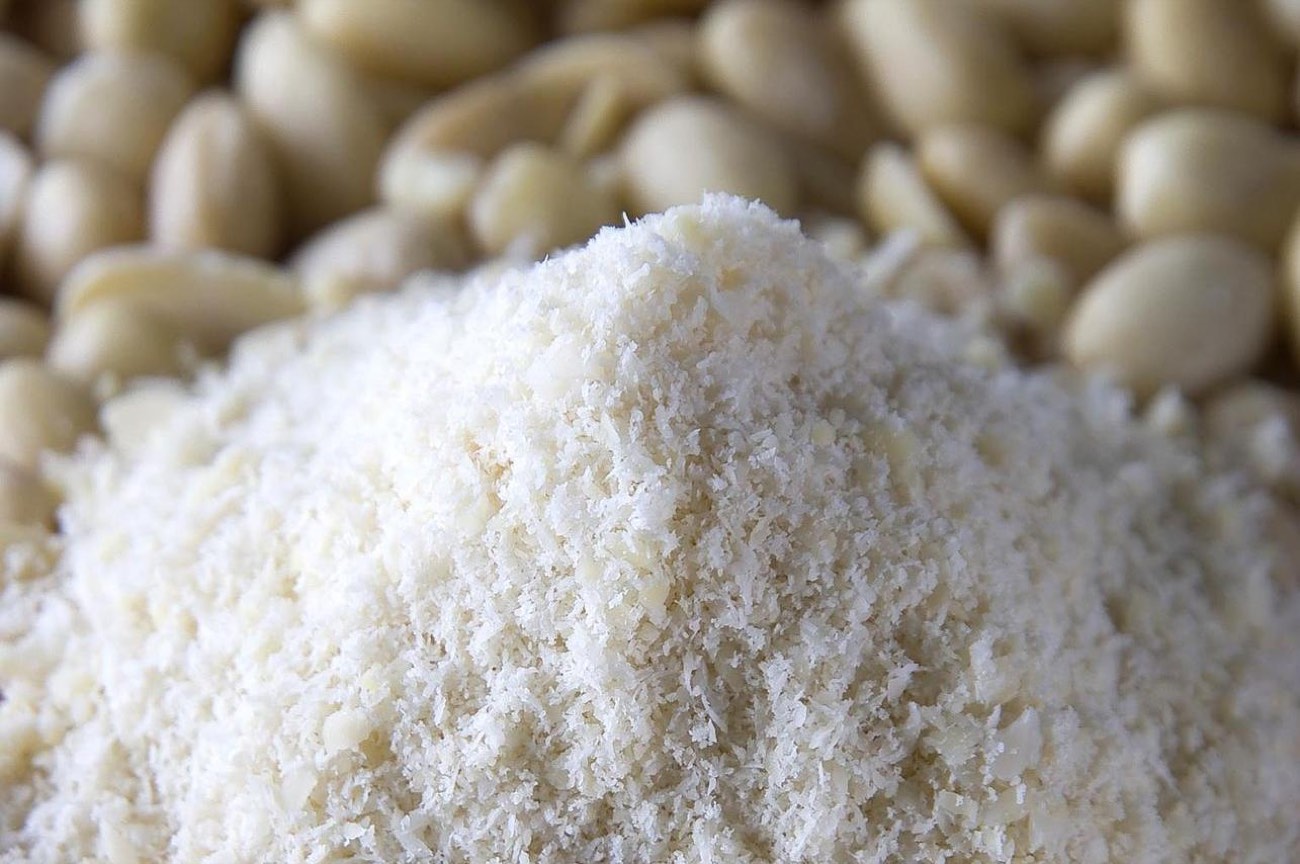
- In Belgian pastry, « milling » designates a family of products: almonds or hazelnuts reduced to particles, alone or blended with sugar. The word names the product, not the machine.
- The common compositions are 100 % almonds, 100 % hazelnuts, 50 % nut / 50 % sugar and almond-hazelnut blends.
- « Almond powder » and « almond flour » designate the same matter, pure ground almond: it is the particle size that separates them, not the nature of the product.
- A 50/50 keeps better and cakes less than pure ground almond: the sugar absorbs part of the oil released during grinding.
- The right purchasing reflex is not to ask for « almond powder » but to state your recipe and target texture: the grind is adjustable.
On a Belgian technical data sheet, « milling » designates a family of products, not a workshop operation. It refers to almonds or hazelnuts passed through the mill and reduced to regular particles, possibly blended with granulated sugar or almond flour. Silly Belgium has milled almonds and hazelnuts in Brussels since 1988. Here is what the term covers exactly, which compositions exist, how to choose your grind according to the recipe, and why two bags labelled « almond powder » can give two different results.
What is milling in pastry?
À retenir : Milling designates a nut reduced to calibrated particles, sold alone or combined with sugar. The term comes from the workshop: the almond or hazelnut is ground between cylinders or in a mill, and the range of products obtained has taken the name of the operation.
The confusion comes from the fact that « milling » sounds like a generic industrial process: cereals, seeds and spices are milled too. In Belgian bakery and pastry, the word has specialised and designates the range of ground almonds and hazelnuts. That is also why the query « broyage » attracts so many searches unrelated to pastry.
It is not a paste. The product stays dry and powdery. Almond paste starts from the same ingredients but goes through mixing and then between rollers, until it forms a supple, homogeneous block, without ever being heated. If the matter can be shaped by hand, you have changed family: see almond paste for baking or marzipan.
Almond powder or almond flour: what is the difference?
The two words designate the same matter: ground almond. What changes is the fineness of the grind. In professional practice the names are largely interchangeable and only the particle size counts.
| Name | What the market understands by it | Typical use |
|---|---|---|
| Almond powder | Blanched almonds finely ground, sandy texture | Macarons, financiers, almond cream |
| Almond flour | Finer grind | Moist cakes, gluten-free preparations |
| Almond pieces | Chopped almonds, not ground | Decoration, crunch, granola |
Erreur fréquente : Ordering « almond powder » without specifying the fineness invites a texture surprise: two suppliers can deliver very different grinds under the same label. State the recipe and the target texture, not just the product name. Both names are covered in detail in almond powder or almond flour.
Which milling compositions exist?
Five compositions cover almost every need of a workshop. At Silly, the range is built around the pure nut and the 50/50 with sugar.
| Composition | What it brings | Recipes |
|---|---|---|
| 100 % almonds | Maximum almond depth, no added sugar | Macarons, cakes, creams |
| 50 % almonds / 50 % granulated sugar | Sweetness, better hold in storage | Biscuits, cookies, tart bases |
| 100 % hazelnuts | Pronounced toasted character | Ganaches, pralines, sauces |
| 50 % hazelnuts / 50 % sugar | A generous balance, easy to dose | Glazes, fillings, ice creams |
| Almond-hazelnut blend | Aromatic complexity | Mueslis, granolas, bars |
Professional packaging ranges from the carton to the bag, according to the volume consumed. For a workshop in full swing, the large format remains more economical, provided it can be used up in good storage conditions.
Fine or coarse grain: how do you choose your grind?
The grind is chosen on mouthfeel, not on a standard. A fine grain lets itself be forgotten and leaves a smooth texture; a coarser grain stays perceptible under the tooth and brings chew.
Three workshop guides. For a preparation that must feel smooth in the mouth (almond cream, macaron, financier), a fine grind is essential: too coarse a grain can weaken the shell and weigh down the batter. For a tart base or a shortbread, a medium grind brings chew without hindering the cut. For a granola or a bar, the frank grain is exactly what you want.
Recommandation : With a manufacturer who mills in-house, the grind is not a fixed catalogue: it is adjustable. Have two finenesses sampled on your real recipe before settling on a specification, then lock it into your technical sheet so that subsequent batches are identical.
Why does a 50/50 behave better than pure ground almond?
Because the sugar absorbs part of the oil released during milling and prevents the product from caking. The almond is roughly half fat by weight; under milling, that oil migrates to the surface of the particles.
A 100 % ground almond left a long time in the bag ends up caking and forming lumps. That is not a manufacturing fault, it is physics: the fatty particles stick together. The 50/50 dilutes that phenomenon, hence a better flow and a longer life.
Le saviez-vous ? : The same logic explains the stability of marzipan: pairing almond with sugar also stabilises its fat. The process is detailed in how is marzipan made.
How do you store ground almonds without them going rancid?
Protected from humidity, sunlight and heat, without letting the temperature drop too low, and respecting the best-before date. The main risk is not microbiological, it is oxidation of the fat, which gives the rancid taste.
Three mistakes are enough to spoil a good product: leaving it in an open bag near an oven, storing it next to strongly scented products (almond picks up odours), and breaking the rotation by always dipping into the most accessible bag. Ground hazelnut goes rancid faster than almond, its fat being more fragile.
Storage times and temperatures by product family are gathered in our storage guide.
Where can you buy professional milling in Belgium?
Silly Belgium has milled almonds and hazelnuts in Jette, Brussels, since 1988, on a production site of more than 5,000 m². The milling range covers the five compositions described above, with a grind adapted to your recipe and packaging from the carton to the bag. Production certified FSSC 22000, hazelnuts Rainforest Alliance Certified.
Samples, technical sheets and particle size specifications on request, through our contact form.
FAQ: milling in pastry
What is milling in pastry?
Milling designates the family of ground almonds and hazelnuts, sold alone or mixed with sugar. The word names the finished product, not the machine. The matter stays dry and powdery, unlike almond paste, which forms a supple, malleable block.
What is the difference between a 50/50 milling and almond powder?
Almond powder is pure ground almond. A 50/50 milling combines 50 % almonds (or hazelnuts) and 50 % granulated sugar. The 50/50 flows better, keeps longer and already sweetens the preparation.
How long does a milling of almonds keep?
Up to the best-before date on the packaging, provided you protect the product from humidity, sunlight and heat, and keep it closed. The limiting factor is oxidation of the fat, not microbiological risk. Ground hazelnut ages faster than almond.
Can wheat flour be replaced by almond milling?
Only partly. Almond has no gluten and therefore brings no structure: beyond a partial substitution, the dough no longer rises and collapses. In a gluten-free recipe, ground almond must be paired with a binder.
What packaging exists for a professional?
From the carton to the bag, according to the volume consumed and the storage space available. The large format costs less per kilo, but is only worth it if the workshop uses it up in good storage conditions, opening included. A well-turned carton beats a half-wasted bag.
Can the grind be set to your own recipe?
Yes, with a manufacturer who mills in-house. Particle size is a production parameter, not a fixed characteristic of the product. The right method is to test two finenesses on the real recipe, then lock in the specification retained.
Sources
Got a project? Let's talk.
Silly Belgium has milled almonds and hazelnuts in Brussels since 1988, with the grind set to your recipe. Samples and technical sheets on request.
Request a sample