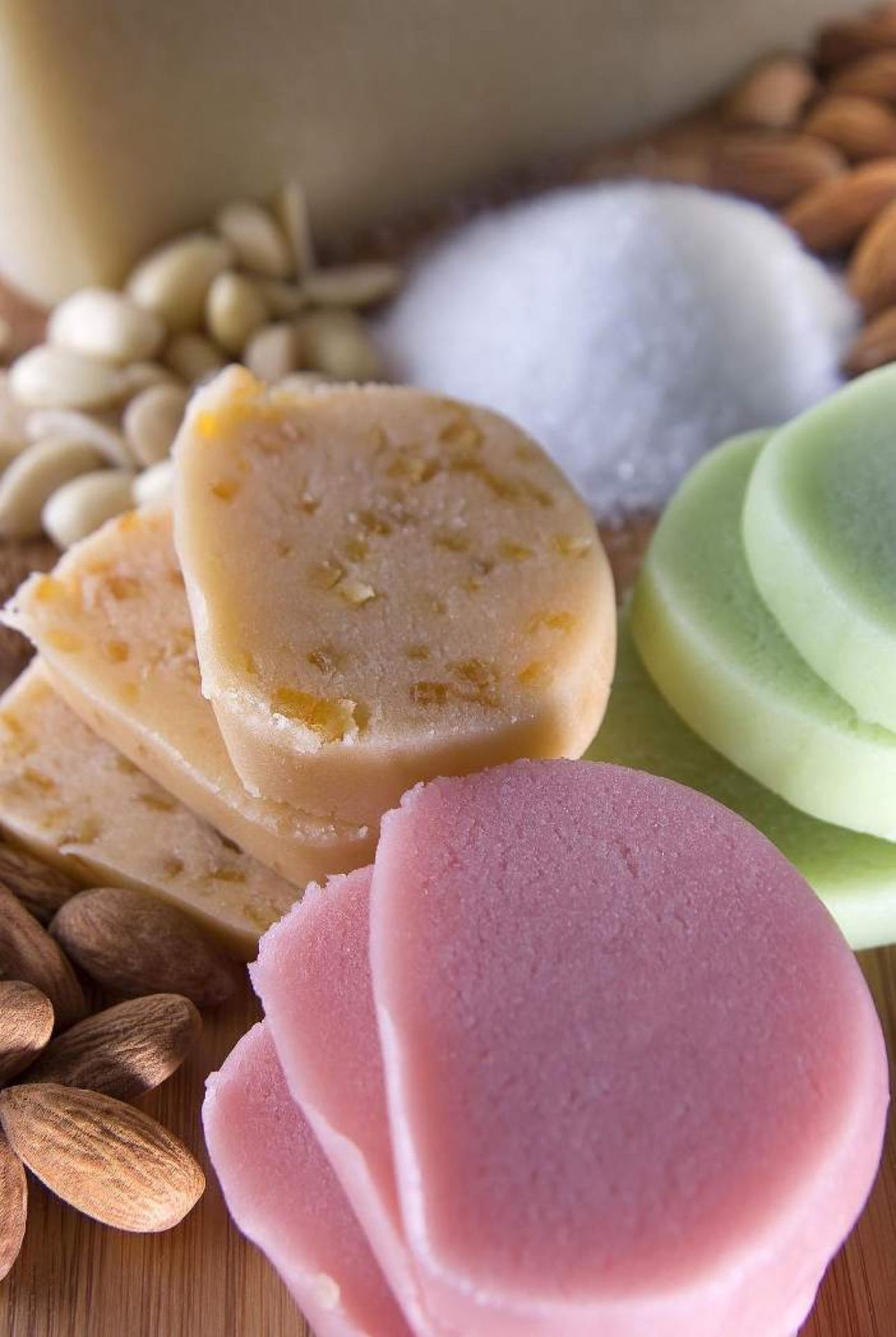
In brief
- Not every marzipan can be baked: the almond/sugar ratio determines how it behaves in the oven.
- The more sugar a marzipan contains, the faster it browns: and the harder it sets as it cools.
- An almond-rich marzipan (60–70%) releases its oil in the oven: it is made to be eaten raw.
- Marzipan 50% is the balance designed for the oven: softness preserved, browning under control.
- Temperature table by use and diagnosis of the 4 classic accidents below.
'Baked marzipan' and its variants add up to more than a thousand monthly searches in Belgium: and plenty of failed batches. A marzipan that cracks, leaks or browns is almost never an oven error: it is a product error. A manufacturer since 1988, Silly Belgium explains what actually happens inside the paste.
The basic rule: the ratio governs the behaviour
Marzipan is a blend of ground almonds and sugar. That ratio, seemingly trivial, governs its entire behaviour under heat:
| Product | Almonds | Behaviour in the oven | Use |
|---|---|---|---|
| Marzipan 60–70% | 60–70% | Releases its oil, slumps | Raw: modelling, figurines |
| Marzipan 50% | 50% | Stable, stays soft | Fillings, frangipane, amandine |
| Marzipan 33% | 33% | Browns and hardens quickly | Decoration, cake covering |
À retenir: For baking, marzipan 50% is generally the best choice: below that (33%), taste and appearance disappoint; above it (60–70%), the paste turns oily in the oven. You choose a marzipan the way you choose a flour: by its use.
Why marzipan cracks
Cracks appear when the surface dries faster than the core. Three triggers: an oven that is too hot (above 180 °C for an unwrapped piece), shaping that has overworked the paste and incorporated air, or a product that was too dry to begin with.
The professional's answer: bake marzipan pieces in a gentle oven (150–160 °C), brush with egg to create a supple film, and rest the shaped paste for 30 minutes before baking to relax the tension.
Why the filling leaks
A filling that leaks is almost always a filling too low in almonds or too loosened. Sugar melts from 160 °C: in a marzipan 33%, the liquefied mass lacks the almond structure to hold together, and it migrates.
By contrast, marzipan 50% contains enough almond matter to set with the filling's eggs and stay in place. If you loosen with egg, stay under 15% of the weight: beyond that you are making a cream, not a filling.
Erreur fréquente: Using the same marzipan for everything 'because it tastes good': the product that excels eaten raw is precisely the one that behaves worst in the oven. That is where banketstaaf and gevulde speculaas accidents come from.
Why it browns too fast
Marzipan browning is a Maillard reaction accelerated by sugar: the more sugar a marzipan contains, the faster it browns. A marzipan 33% on a cake turns brown within minutes under a grill.
Indicative temperatures, to adjust to your oven:
| Use | Temperature | End signal |
|---|---|---|
| Filling inside a piece (galette, staaf) | 170–180 °C | Core at 85 °C |
| Unwrapped pieces (eating marzipan, petits fours) | 150–160 °C | Even light-golden colour |
| Browning a decoration (glazing under the grill) | Grill, a few minutes | Constant watching |
Recommandation: To colour a decoration without drying the piece, use a blowtorch on the surface rather than the oven: the colour is immediate and the core stays intact.
The diagnosis in one table
| Symptom | Probable cause | Solution |
|---|---|---|
| Surface cracks | Oven too hot, paste too dry | 150–160 °C, egg wash, rest before baking |
| Filling leaks | Marzipan too sugary or too loosened | Massepain 50 %, œufs < 15 % |
| Oil beading | Marzipan 60–70% put in the oven | Keep the 60–70% for raw work |
| Excessive browning | High sugar content, oven too fierce | Lower by 20 °C, shield with paper |
The right product for the right bake
Silly Belgium fabrique à Bruxelles les trois pourcentages : massepain 60–70 % pour le modelage, marzipans and almond pastes 33 % pour le décor, et massepain 50 % pour les fourrages et la cuisson, celui de la professional frangipane. Unsure which product suits your process? Our technical sheets have the answer, samples included.
FAQ: marzipan in the oven
Can marzipan be baked in the oven?
Yes, but not just any marzipan: marzipan 50% is designed for the oven, while an almond-rich marzipan (60–70%) releases its oil under heat and should be kept for raw work.
At what temperature should marzipan be baked?
150 to 160 °C for unwrapped pieces (light golden colour), 170 to 180 °C for a filling enclosed in pastry, with the core at 85 °C. Under the grill, a few minutes are enough to colour a decoration: under constant watch.
Why does my marzipan crack during baking?
The surface dries faster than the core: oven too hot, paste overworked or too dry. Bake more gently, brush with egg and rest the shaped pieces for 30 minutes before they go in.
Why does my almond paste filling leak?
The marzipan used is too sugary (sugar melts from 160 °C) or too loosened with egg. Use a marzipan 50% and keep the added egg under 15% of the weight.
Which almond percentage should you choose for baking?
Marzipan 50% is generally the best balance: stable in the oven, nice browning, good taste. A 33% gives a flatter result in taste and appearance; a 60–70% turns oily when baked and should be kept for raw work.
Where can you find professional marzipan 50% in Belgium?
At Silly Belgium, a Brussels manufacturer since 1988: marzipan 50%, FSSC 22000-certified, in professional pack sizes, with technical sheets and samples on request.
Sources
Got a project? Let's talk.
33%, 50% or 60–70%: three marzipans, three uses. Our technical sheets point you the right way: samples on request.
Request a sample