In brief
- « Craft » is not a protected claim in confectionery: the word guarantees nothing on its own and can appear on very different products.
- The first verifiable criterion is the almond content, which must be stated plainly. A manufacturer who does not communicate it is a signal in itself.
- The opposition of craft against industrial is partly false: automation serves consistency, and consistency is a quality requirement, not its opposite.
- The real dividing line is transparency: origin of the almonds, short ingredient list, complete technical sheet and a sample before ordering.
- Seven criteria let you judge a product by testing it: almond content, origin, ingredient list, texture, behaviour when shaping, documentation, capacity for bespoke work.
In Belgium, no text reserves the word « artisan » for a particular mode of production in confectionery. A marzipan can therefore be presented as artisan without that committing much. Rather than trusting the label, it is better to test the product itself. As a marzipan manufacturer in Brussels since 1988, we set out seven verifiable criteria here, some of which can be checked in thirty seconds on a sample, and we are willing to say where industrial production is right against craft.
Does « craft » mean anything on a marzipan?
À retenir : No: « craft » is not a protected claim in confectionery, and its use is not framed by any definition of composition. The word describes an intention of manufacture, not a guarantee of result.
That does not make it a lie. A workshop working from handed-down recipes, checking its material by eye and shaping by hand is doing genuine craft work. It is simply that the buyer cannot rely on the word: they must rely on verifiable elements.
Erreur fréquente : The classic mistake is to set craft against industrial as good against bad. An automated line produces with a consistency no human hand achieves, and consistency is precisely what a pastry chef expects from a raw material. The subject is not the machine, it is what goes into it.
Criterion 1: is the almond content stated plainly?
A serious manufacturer states its almond content without being asked. It is the parameter that determines flavour, hold and price: withholding it has only one reason.
Common contents run from 22 % to 50 % almonds. A marzipan whose percentage nobody can tell you is a product you can neither compare nor reproduce from one batch to the next. What each content covers is explained in our definition of marzipan.
Criterion 2: where do the almonds come from?
The origin of the almonds changes the aromatic profile as much as the content changes the intensity. The three dominant origins in pastry are the United States, Spain and Portugal.
The question to ask is not only « where do they come from » but « at what stage do you buy them ». Buying at origin, in the growing country, where the almonds are shelled, blanched and packed, is not the same as taking over a batch from a reseller or a wholesaler. That is what makes it possible to hold a constant flavour over several years.
Criterion 3: is the ingredient list short?
A marzipan is defined by two ingredients: almonds and sugar. Anything added must have a technical reason.
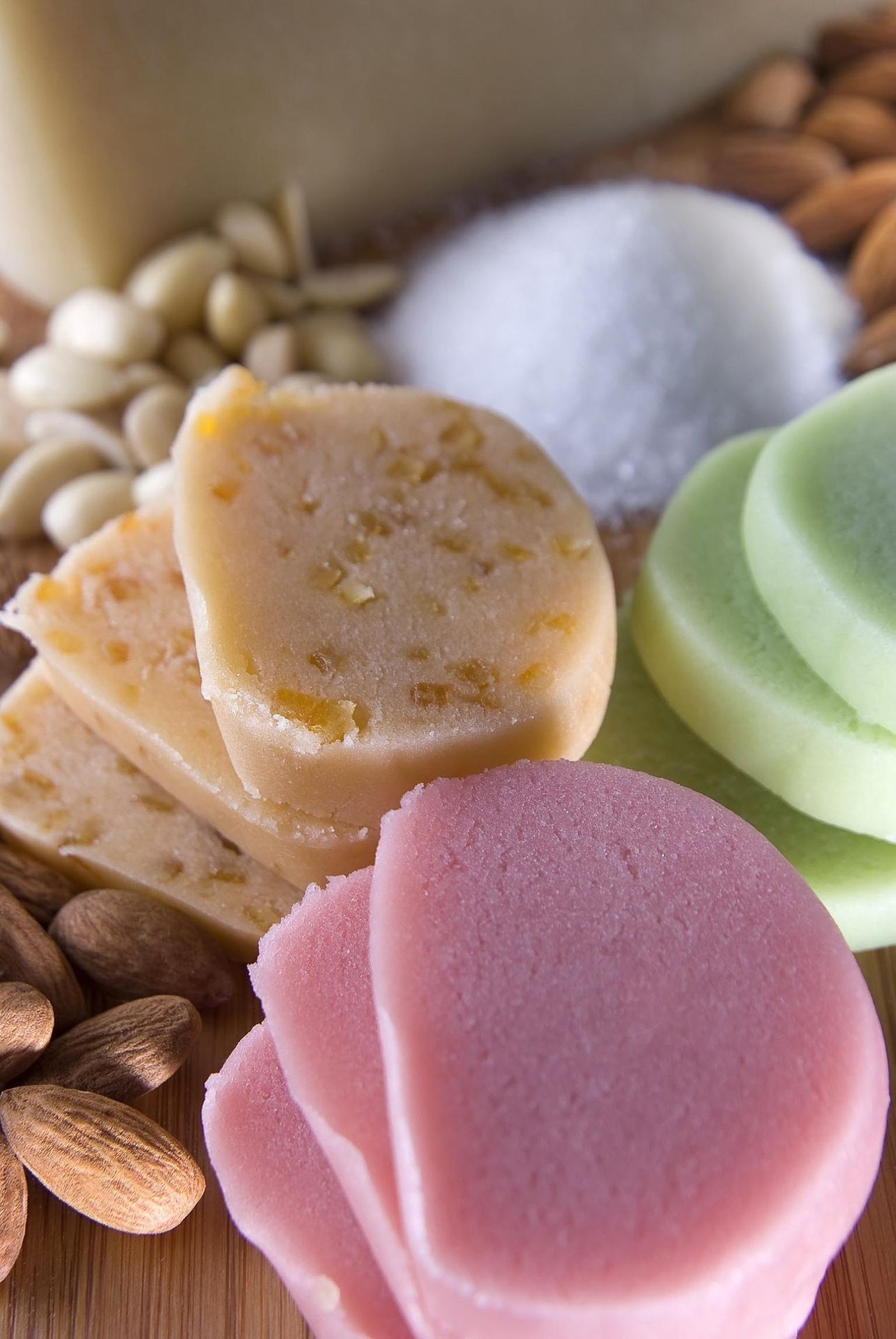
Some additions are perfectly legitimate: a speciality marzipan deliberately includes diced candied orange, raspberry, pistachio or mocha paste. Others serve to compensate for a far lower almond content, for economic reasons. The useful question is: does this ingredient add something, or replace something?
Criteria 4 and 5: what do texture and shaping tell you?
Two simple tests are done on a sample, without equipment. They do not replace a technical sheet, but they quickly eliminate products unsuited to your use.
| Test | What you do | What it reveals |
|---|---|---|
| Texture | Press the paste between your fingers | A paste that crumbles is too dry for modelling |
| Shaping | Roll a thin rope and fold it in two | Clear cracks signal a paste that will not hold detail |
| Nose | Smell the paste at room temperature | The almond must be perceptible; a neutral nose betrays a low content |
| Palate | Taste it on its own | The light bitterness of the almond must prevail over the sugar |
Recommandation : Run these tests on the grade you actually intend to order, not on the premium sample. A manufacturer who can only sample you its best content is not helping you decide.
Criteria 6 and 7: documentation and bespoke capability
Documentation is the most discriminating criterion, and the most neglected at purchase. Technical sheet, allergen list, specifications, certificates: these documents must exist and reach you without negotiation.
The seventh criterion is the capacity for bespoke work. A manufacturer genuinely in command of its production can adjust an almond content, a flavour, a format or a packaging. A reseller cannot: it sells what it has in stock. That difference between manufacturing and distributing is covered in manufacturer or wholesaler.
The documentary requirements to set out precisely to a supplier are detailed in technical sheets, allergens and FSSC 22000.
Should you prefer a craft marzipan?
Our position, as a manufacturer, is nuanced and we stand by it. Craft production is right about the formula and the direct link with the customer; industry is right about consistency and traceability. A good supplier takes both.
At Silly, automated lines ensure short lead times and a constant quality, while the recipes and the shaping gestures remain those handed down since 1988. HACCP procedures have applied since 2001, FSSC 22000 certification since 2021. That is not a compromise, it is the only way to hold both promises at once.
And once those seven criteria are met, one step remains that nothing replaces. When the technical data sheet matches your needs, ask for a sample of the exact reference you intend to buy, at the planned content and format, and test it in your real application before ordering. That is where the purchase is decided. See our range of marzipan and our page on craftsmanship and quality.
FAQ: craft and industrial marzipan
Is the word « craft » regulated for marzipan?
No. In confectionery, « craft » is not a protected claim attached to a definition of composition. The term describes a way of producing, not a verifiable guarantee. Better to judge on the stated almond content, the origin of the almonds and the documentation supplied.
How do you recognise a good marzipan by tasting?
The almond must be smelt at room temperature and prevail over the sugar on the palate, with a light bitterness. The paste must stay supple without crumbling. A neutral nose and a crumbly texture signal a low almond content.
Is industrial marzipan of lower quality?
Not necessarily. Automation brings a consistency that entirely manual shaping does not achieve, and that constancy is a quality requirement for a pastry chef. What counts is the formula, the origin of the almonds and traceability, not the degree of mechanisation.
Which almond content corresponds to a quality marzipan?
There is no universal threshold. The 33 % is the standard of Belgian artisans, the 40 % and the 50 % serve fine pieces, chocolate work and fillings, the 22 % suits small decorations and covering cakes, in a use close to sugarpaste. The right content is the one that matches your application.
Which documents should you ask for before ordering?
The product technical sheet, the allergen list, the packaging specifications and the certificates for the production site. A supplier who keeps you waiting for these documents, or supplies them incomplete, is announcing how it will handle a complaint.
Where can you find craft marzipan in Belgium?
From manufacturers who produce themselves rather than from resellers. The simple test is to ask for an adjustment of almond content or format: a manufacturer can do it, a distributor sells its stock. Silly Belgium has produced in Jette, Brussels, since 1988.
How do you test a marzipan before ordering?
Validate the technical data sheet first, then ask for a sample of the exact reference you intend to buy, at the planned content and format. Test it in your real application, not on an isolated trial. A sample of a different quality tells you nothing about the product you will receive.
Sources
- Marzipan (Wikipedia)
- FSSC 22000: food safety certification scheme
- HACCP: Belgian Federal Agency for the Safety of the Food Chain (FASFC)
Got a project? Let's talk.
Silly Belgium makes five grades of marzipan in Brussels, with almond contents stated and technical sheets supplied. Samples on request.
Request a sample