In brief
- Three very different trades hide behind the same word: the manufacturer, the distributing wholesaler and the buying group or cash and carry.
- A confectionery wholesaler does not manufacture: it lists, stocks and delivers. Its value is the breadth of range and immediate availability.
- A manufacturer can adjust a formula (almond content, grain size, format): that is what a distributor structurally cannot do.
- For a workshop, the right arrangement is often mixed: the manufacturer for the signature materials, the wholesaler for the long tail.
- Four questions settle it before the first order: minimum order, real lead time, quality documentation and sampling policy.
In Belgium, the expression « confectionery wholesaler » designates at least three distinct commercial realities, and you do not approach each of them in the same way. The manufacturer produces what it sells and can adjust a formula. The distributing wholesaler lists hundreds of lines and delivers fast, but changes nothing. The buying group or cash and carry plays on price and self-service. As a manufacturer in Brussels since 1988, we set out here what each one can do, with the questions to ask before placing a first order.
What does a confectionery wholesaler actually do?
À retenir : A confectionery wholesaler lists, stocks and delivers products it does not manufacture. Its added value is the breadth of range and availability, not command of the product.
In practice it buys from manufacturers and importers, builds a catalogue covering dozens of families, and offers a craftsperson a single order where six supplier accounts would otherwise be needed. It is a trade of logistics and assortment.
What it structurally cannot do: modify a formula, change a particle size, produce a dedicated format. Those requests go back up to the manufacturer, with lead times and minimums that are completely different.
Three counterparts, three logics
The choice is not made on price but on what you expect from the supplier.
| Manufacturer | Distributing wholesaler | Buying group or cash and carry | |
|---|---|---|---|
| Product | What it makes, adjustable | Wide catalogue, not modifiable | Tight assortment, standard |
| Bespoke work | Yes: content, grain size, format, flavour | No | No |
| Minimum order | Higher, by production run | Moderate | Low or none |
| Lead time | According to the production schedule | Short, from stock | Immediate, self-service |
| Documentation | First-hand technical sheets | Forwarded sheets | Variable |
| Good for | Signature materials, regular volumes | Long tail, emergency top-ups | Top-ups, small quantities |
Recommandation : For most workshops the right arrangement is mixed: the manufacturer for the two or three materials that define your products, the wholesaler for everything else. Trying to centralise everything with a single counterpart costs either in flexibility or in price.
Which products do you find at a confectionery wholesaler?
The scope of confectionery is broader than that of bakery and partly overlaps that of chocolate work. A typical catalogue covers six families.
| Family | Examples |
|---|---|
| Almond pastes and marzipans | Modelling marzipan, almond paste for baking, speciality marzipans |
| Hazelnut crunch, nougatine and praliné | Hazelnut crunch (praligrain, pralin), nougatine, praliné paste |
| Ground almonds and hazelnuts | Ground almonds and almond flour, ground hazelnuts, blends |
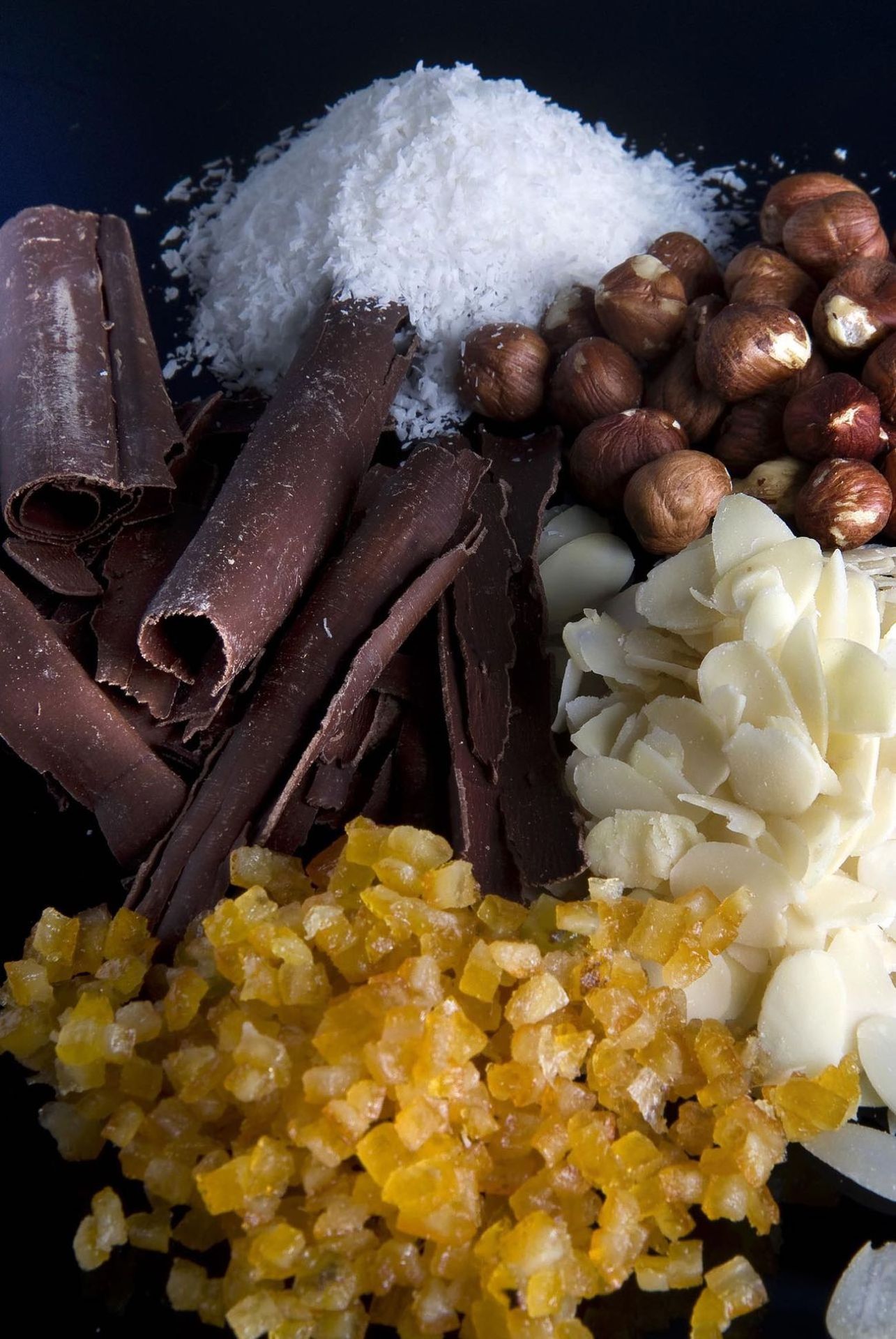
| Nuts and staple items | Whole almonds, flaked, in pieces, hazelnuts, desiccated coconut |
| Candied fruit | Diced candied orange, mixed peel, whole fruit |
| Chocolate and coatings | Couvertures, fillings, decorations |
Silly Belgium manufactures the first three families and selects the base products (almonds, hazelnuts, coconut, candied fruit) for its wholesale and chocolate-making customers. On candied fruit, see how to choose, use and store it.
Should you go through a wholesaler or a manufacturer?
The question is settled material by material, not supplier by supplier. The right criterion is whether the material defines your finished product or not.
For a signature material, the one your customers recognise, the manufacturer imposes itself: it gives you access to the formula, to consistency and to the possibility of adjusting. For a commodity material you consume in small quantities, the wholesaler is more efficient.
The detailed analysis of that trade-off, with its effects on price and traceability, is in manufacturer or wholesaler: how professionals buy their raw materials.
What should you check before placing a first order?
Four questions are enough to know whether a supplier suits your workshop. Ask them before the first order, not after the first problem.
| Question | What it reveals |
|---|---|
| What is the minimum order, in value and per line? | Whether you can work just in time or will have to stock |
| What is the real lead time, and the one in the festive season? | November's lead time is never March's |
| Which documents do you supply, and within what time? | Technical data sheet, allergens, certificates: a refusal is a signal |
| Do you sample the reference I will use in production? | A sample that does not match the product actually used does not allow the supplier to be judged |
Erreur fréquente : Starting a relationship on price alone is the most frequent mistake. A gap of a few percent per kilo is wiped out by a single stock-out in the festive season. And the sample must cover the reference, the content and the grain size you intend to buy: a sample from a higher range teaches you nothing about the product you will receive. The five criteria for selecting a supplier are developed in choosing your pastry ingredient supplier in Belgium.
Are the documentary requirements the same everywhere?
No, and this is a point to watch: a distributor's documentation is always second-hand. It forwards what its own supplier gave it, with the lag that implies.
For a precise technical question (behaviour when baked, actual content, origin of a batch, update of an allergen sheet), the manufacturer-wholesaler-craftsperson chain lengthens the response time and introduces a risk of out-of-date information.
What to require and how to phrase the request is detailed in technical sheets, allergens and FSSC 22000.
Sourcing from a Belgian manufacturer
Silly Belgium has manufactured marzipan, hazelnut crunch and nougatine in Jette, in Brussels, since 1988, on a site of more than 5,000 m². The company works with artisans, industrial users, wholesalers and associations. Marzipan comes in cartons of 5, 10 or 15 kg, in buckets of 4, 5 or 6 kg and in bars of 250 g to 1 kg; hazelnut crunch in cartons of 5 to 10 kg, in buckets of 2 to 5 kg and in 20 kg bags.
Depending on your profile, see the craftspeople, wholesalers or industrial customerspages, or open the conversation through the contact form.
FAQ: confectionery wholesaler
What is a confectionery wholesaler?
An intermediary that lists, stocks and delivers confectionery raw materials it does not manufacture. Its value is the breadth of range and immediate availability. It cannot, on the other hand, modify a formula, a particle size or a format.
What is the difference between a wholesaler and a manufacturer?
The manufacturer produces what it sells and can adjust a formula: almond content, grain size, flavour, format. The wholesaler distributes a catalogue it has not produced. The first serves signature materials, the second the long tail and emergency top-ups.
How do you start working with a confectionery wholesaler?
Generally on presentation of a company number and a professional activity, with a minimum order to respect. Ask four questions from the outset: minimum, real lead time in the festive season, documentation supplied and sampling policy.
Which products belong to confectionery rather than bakery?
Almond pastes and marzipans, hazelnut crunch, nougatine and pralinés, ground almonds and hazelnuts, nuts, candied fruit and chocolate coatings. The scope partly overlaps that of chocolate making.
Can a wholesaler supply a technical sheet?
Yes, but it is second-hand: it forwards its own supplier's document, with a risk of an out-of-date version. For a precise technical question or an allergen update, the response time lengthens compared with a direct manufacturer.
Does a small pastry shop need a wholesaler or a manufacturer?
Often both. The manufacturer for the two or three materials that define your products, where consistency and the ability to adjust matter. The wholesaler for the references consumed in small quantities, where availability outweighs command of the product.
Sources
Got a project? Let's talk.
Silly Belgium manufactures in Brussels and supplies artisans, wholesalers and industrial users. From the 250 g bar to the 20 kg bag, samples on request.
Request a sample