In brief
- Glossy nougatine is an almond or hazelnut caramel poured thin, shiny and crisp.
- “Glossy” refers to its smooth, mirror-like lustre, not a cold preparation.
- Success rests on three points: caramel at the right colour, roasted nuts, quick pouring.
- It serves as a decoration, a base for a mounted piece, a crisp foundation or broken into shards.
- Kept well and dry, nougatine lasts several weeks; its enemy is humidity.
Searched nearly 1,600 times a month, glossy nougatine intrigues as much as it intimidates: a caramel that must be golden without being bitter, supple to pour then clean at the break. At Silly, a Belgian nougatine manufacturer since 1988, here is what it really is, how you achieve it, and the pro benchmarks to stop getting it wrong.
What is glossy nougatine?
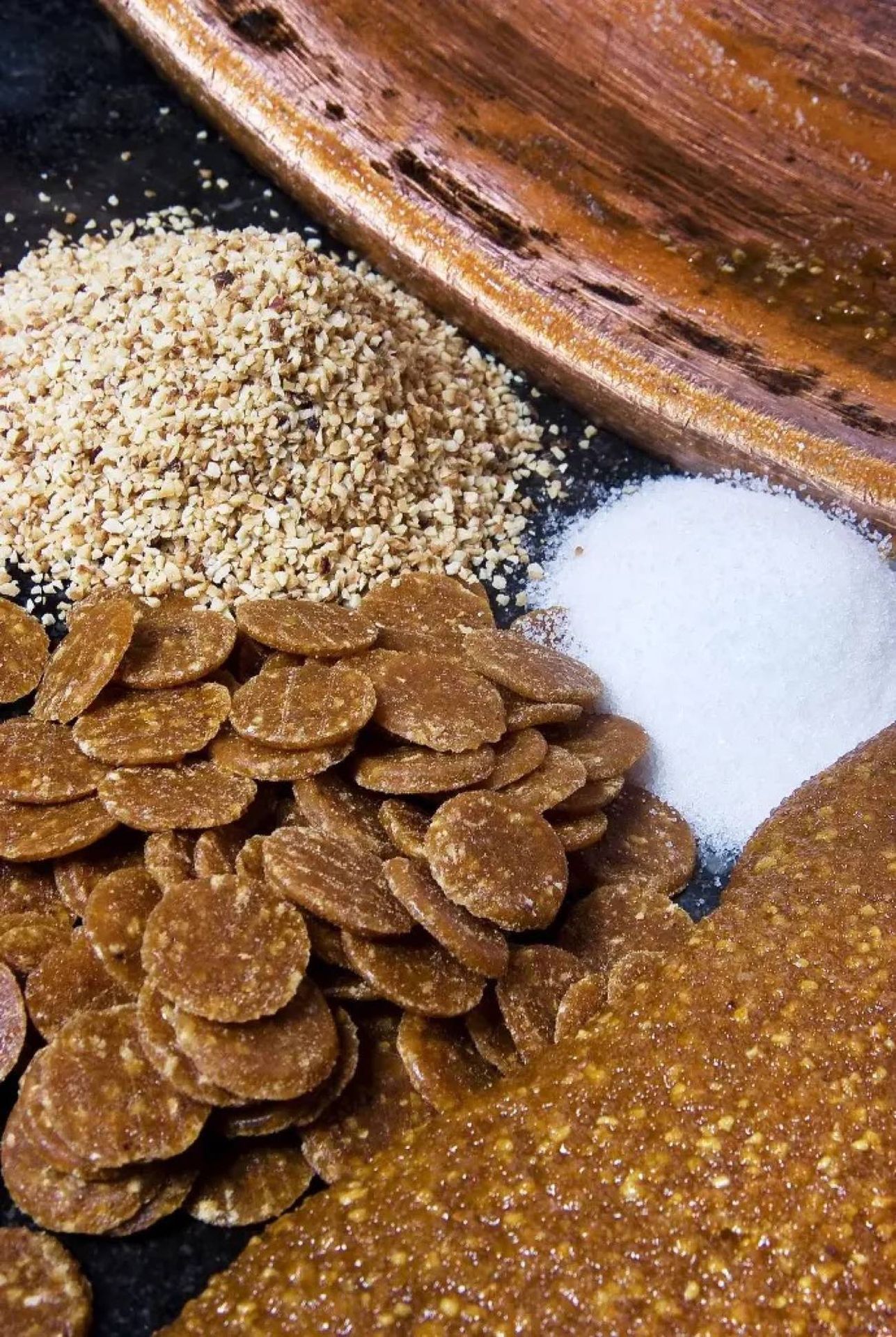
Glossy nougatine is a sugar caramel into which chopped almonds or hazelnuts are folded, then rolled out into a thin, smooth and shiny sheet. The word “glossy” does not refer to cold but to that lustrous, almost mirror-like look it takes on as it cools.
Once set, it is crisp and crunchy. It is used as a decoration, as the base of a mounted piece, crushed into shards over an entremets, or cut hot into geometric shapes.
Glossy nougatine or “dry” nougatine: what's the difference?
The confusion is common. It is the same principle (caramel + nuts), but the result differs depending on how the sugar is cooked and how thinly it is rolled out:
| Type | Appearance | Typical use |
|---|---|---|
| Glossy nougatine | Thin, smooth, shiny, very crisp | Decorations, bases, shards on entremets |
| Thick nougatine | Denser, grainy | Tart bases, pieces to bite into |
| Brésilienne (praligrain) | Fine granules of caramelised nuts | Coating, sprinkling, ice creams |
To understand the kinship between these three families, also read our guide on brésilienne (praligrain) and the complete guide to nougatine.
Which ingredients for a successful glossy nougatine?
The list is short, quality is everything: sugar (or a sugar + glucose blend to prevent crystallisation), roasted and chopped almonds or hazelnuts, and sometimes a touch of butter for suppleness when pouring.
The nuts must be roasted and still warm when folded in: a cold nut brings down the caramel's temperature and sets it too fast. At Silly, almonds and hazelnuts are ground and calibrated on site, which guarantees an even distribution throughout the sheet.
How do you make glossy nougatine? The 5 steps
1. Roast the nuts — almonds or hazelnuts oven-roasted until they smell toasted, kept warm.
2. Cook the caramel — the sugar (with a little glucose) is melted to a light amber colour. Too pale: bland and soft. Too dark: bitter.
3. Fold in the nuts — off the heat, add the warm nuts and mix quickly to coat them.
4. Roll out — the mass is poured onto a silicone mat and spread thinly with an oiled rolling pin, while it is still hot and supple.
5. Cut or let it set — cut the desired shapes while hot, then leave to harden. Once cold, nougatine can no longer be reworked.
Recommandation — Work fast: nougatine sets as it cools. Roll out and cut while it is still hot; the pros keep it supple under a lamp or in the oven with the door open.
The 3 mistakes that ruin a glossy nougatine
A poorly controlled caramel. This is the number one mistake: too fierce a heat burns the sugar (bitterness); too gentle and it crystallises. Aim for an even amber shade and cut the heat in time.
Working too slowly. Nougatine sets as it cools. You must roll out and cut while it is still hot; the pros keep it supple under a lamp or in the oven with the door open.
Leaving it in humid air. The caramel absorbs moisture and turns sticky then soft. Store it sheltered, never in the fridge (too humid).
How do you store glossy nougatine?
Kept well and dry, in an airtight box with a desiccant sachet, at room temperature, glossy nougatine keeps for several weeks without losing its crunch. Absolutely avoid the fridge and humid rooms: it is humidity, not time, that softens it.
For regular professional use, Silly manufactures nougatine in sheets, granules and custom shapes, ready to use and calibrated to hold up in the display case.
Erreur fréquente — Storing nougatine in the fridge is a false good idea: the humidity softens it. Dry at room temperature, in an airtight box, is the only good way to keep it.
Frequently asked questions about glossy nougatine
Why is it called “glossy” nougatine?
Because as it cools, the caramel takes on a smooth, shiny look, as if glazed. The term describes the lustrous surface, not a cold or frozen preparation.
What is the difference between nougatine and glossy nougatine?
It is the same principle (caramel + nuts). The glossy version is rolled out very thinly for a smooth, shiny and crisp result, ideal as decoration; thick nougatine serves as a crunchy base.
Why does my nougatine turn soft?
Because of humidity: the caramel absorbs it and softens. Keep it dry in an airtight box with a desiccant, never in the fridge.
Can you make nougatine without glucose?
Yes, with sugar alone, but the risk of crystallisation increases. A little glucose or a few drops of lemon juice stabilises the caramel and makes rolling out easier.
How do you colour or flavour nougatine?
The colour comes mainly from cooking the caramel. You can vary the nuts (almond, hazelnut, sesame); strong flavourings cope poorly with high temperature, so they are reserved for toppings.
Where can you buy professional nougatine in Belgium?
Silly Belgium has been making nougatine in Brussels (Jette) since 1988, in sheets, granules and custom shapes. Request a sample via the contact page.
Sources
Got a project? Let's talk.
Silly Belgium has been making marzipan, brésilienne, nougatine and ground almonds in Brussels since 1988. Request a sample or a tailored quote.
Request a sample